HomeBeyond the Fad: Top Residential Interior Design Trends 2026
Beyond the Fad: Top Residential Interior Design Trends 2026
Published on May 16, 2026
Updated on May 16, 2026
A home reveals itself much like a well-composed novel: the opening line sets tone and tempo, the chapters build tension and release, and the final page leaves the reader changed. I learned that lesson not in a classroom, but on a jet-lagged morning in Shanghai, sketching a lobby concept for the St Regis. My mentor placed a hand on my tracing paper and said:
“A guest should feel the story before they see it.”
Sixteen years later, every space I create – from a bookstore in Toronto to a private retreat in Muskoka – begins with that same pursuit of quiet storytelling.
You and I are about to take a slow walk through a future-ready home, one that holds its value not because it chased a fleeting trend, but because each choice solves a real-world problem with grace. Along the way, I will point out the 2026 residential interior design trends worth your budget and your trust.
Take a breath. Open the door. Let’s begin.
Why 2026 Demands More Than Aesthetic Interior Design Novelty
Before we trace floorboards, it helps to understand the forces reshaping residential design in 2026:
Emotional Burnout from Minimalism: Years of cool whites and sharp angles promised clarity still often delivered fatigue. Clients now seek rooms that wrap around them the way a cashmere scarf closes out winter wind.
Craft Reclaiming Ground from Mass Production: Supply-chain shocks exposed the fragility of fast decor. Artisanship – once romanticised – is now recognised as a pragmatic path to longevity.
Technology Quietly Embedding Itself: Smart systems are no longer conversation pieces. They’re infrastructure. Their silence lets materials and memories speak louder.
Accountability: Regulations are catching up with conscience. Low-VOC is a baseline. Circular materials are moving from pilot projects to mainstream specification.
In no particular order, here are the residential interior design trends for 2026.
Trend #1. The Entry Hall and the Return of Saturated Warmth.
A monochrome foyer offers visual calm but emotional chill. Guests arrive, remove coats, and feel… nothing.
In 2026, colour graduates from accent to architecture. Walls, trim, and even air-supply grilles bathe in a single, rich tone, a technique we call full-scope colour immersion. Benjamin Moore’s “Silhouette” – an espresso softened by charcoal – sets a hushed, luxurious baseline.
Underfoot, reclaimed marble mosaic in terracotta and onyx sings against the deep walls.
A ribbed walnut bench offers a tactile punctuation. Structured still inviting.
An antique brass picture light coaxes warmth from a sepia family photograph.
Why It’s Investment-Grade
Scratches and scuffs read as patina, not damage.
Buyers increasingly perceive saturated spaces as custom millwork rather than paint alone, elevating property value.
Emotionally, the colour shift marks a transition from public to private life. Indispensable to stressed professionals.
Trend #2. The Living Room and Textures That Invite the Hand.
Growing up in Guangzhou, I spent afternoons at my grandmother’s mahjong table, the lacquered wood cool beneath tea-warmed fingertips. Texture has been a lifelong tutor, and it’s reclaiming centre stage.
Smooth, reflective surfaces photograph well but feel sterile under palm and heel.
Layer textures that ask to be touched: hand-trowelled plaster, live-sawn oak, deeply veined Arabescato marble, and matte velvet. In a recent project, we sheathed a fireplace in fluted limestone. The stone absorbs daylight, releasing it back at dusk in a soft, inner glow. No light fixture required.
A cognac-toned mohair sofa catches and scatters light like brushed suede.
Linen drapery, double-lined, billows with the slightest draft, turning air movement into theatre.
A Japanese nambu-tekki iron kettle on a low travertine plinth adds a subtle metallic click each time it meets the cup.
Why It’s Investment-Grade
Authentic materials age into character, not obsolescence.
Maintenance becomes simpler: natural marble etches less conspicuously than synthetic gloss chips.
Textural complexity fosters grounding, a tangible antidote to screen time.
Trend #3. Curated Storytelling: Personalisation Without Chaos.
Clients collect: Parisian flea-market mirrors, Balinese batiks, their child’s first clay dinosaur. Display everything and rooms feel chaotic. Store it away and the home loses soul.
A narrative audit. We catalogue every object’s origin and emotional weight, then orchestrate placement through rhythm and negative space. Linear LED shelves recess into walls, illuminating heirloom ceramics. A single, large-scale photograph counterbalances smaller curios.
I’ve learned this retail’s golden rule a long time ago: the human eye rests after every 60 inches of visual data. I borrow that cadence at home, ensuring each treasured object has breathing room.
Museum-grade, low-iron glass protects a vintage Louis Vuitton trunk without glare.
Charcoal linen backing fabric quiets the vignette, directing attention to patinated brass corners.
Indirect lighting sets objects afloat, turning evening strolls through the living room into private gallery tours.
Why It’s Investment-Grade
Emotional ROI compounds: your collection gains significance as stories layer over time.
Flexibility: shelves and tracks accommodate new acquisitions without construction dust.
A personalised interior resists commodification, insulating your home from market over-saturation of a single look.
Trend #4. Curves and Organic Forms.
Rectilinear layouts optimise square footage on a drawing set. Human bodies prefer arcs.
Introduce radius geometry: a kidney-shaped sofa, an elliptical coffee table, arched doorways. CNC milling makes bespoke curved millwork economically viable. In a lake house, we sculpted a white-oak kitchen island whose edge gently traces the body’s standing stance, allowing cooks and guests to flow without side-stepping.
A wool-silk blend rug echoes the curve, its gradient dyeing mimicking shoreline shallows.
Integrated LED toe-kicks wash the radius with light, accentuating its sculpture.
Overhead, a suspended alabaster disc mirrors the island’s silhouette, tying horizontal and vertical space.
Why It’s Investment-Grade
Ergonomics reduce long-term impact injuries (ask any parent of a toddler with a forehead bruise).
Curves visually stretch compact rooms by guiding sightlines.
Fabrication files can be archived. Need a matching banquette in five years? Re-cut, not redesign.
Trend #5. NeoDeco.
Many clients crave glamour but fear tipping into pastiche – the cinematic set that lives poorly.
NeoDeco distills 1920s motifs into modern restraint. Think reeded walnut, burnished brass in matte finish, stepped stone in geometric rhythms. During my tenure at Burdifilek, I saw how a single Deco reference – a fluted column, a bronze reveal – could lift an otherwise minimal shop into quiet opulence. The trick is dosage.
A brass inlay arcs through wide-plank oak flooring: subtle underfoot, striking when light glances off bevelled edges.
Cabinetry pulls in patinated bronze offer a cool, substantial grip.
A fan-shaped alabaster sconce diffuses light like candle glow filtered through parchment.
Why It’s Investment-Grade
Geometry this simple resists fashion swings. It survived Art Nouveau, Bauhaus, and Post-modernism.
Mixed metals such as brass and bronze can be refinished indefinitely.
NeoDeco bridges generational taste, a hedge against future resale dilemmas.
Trend #6. Patterns That Breathe.
Open-concept homes risk feeling cavernous, still traditional pattern layering can overwhelm sightlines.
Pattern zoning. Devote entire volumes – a stairwell, a powder room, a ceiling bay – to assertive pattern, while adjacent planes rest. In a Toronto Beaches renovation, we drenched the vestibule ceiling in a hand-painted circus stripe, letting white oak walls neutralise peripheral vision. Guests look up, smile, then exhale into calmer spaces.
The matte paint softens acoustics, absorbing entryway echoes.
A faint citrus scent from eco-friendly pigment lingers for weeks, imprinting a sensory “welcome back.”
The stripe’s rhythm subconsciously cues tempo – quickening the remove-shoes flow in a busy household.
Why It’s Investment-Grade
Strategic pattern hides inevitable scrapes in high-traffic niches.
Limited application curtails material costs without sacrificing impact.
Pattern zoning can be updated with minimal labour, preserving the underlying envelope.
Trend #7. Light as Sculpture, Illumination as Narrative.
Ceiling pot-lights deliver uniform lumens but zero atmosphere. They flatten art, erase texture, and fatigue eyes.
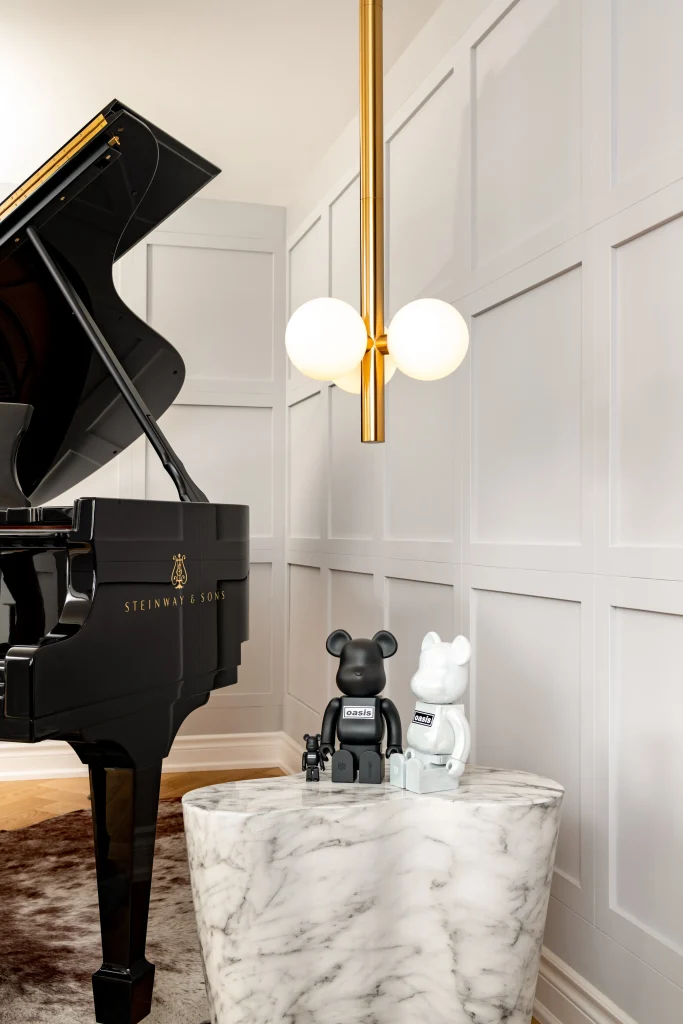
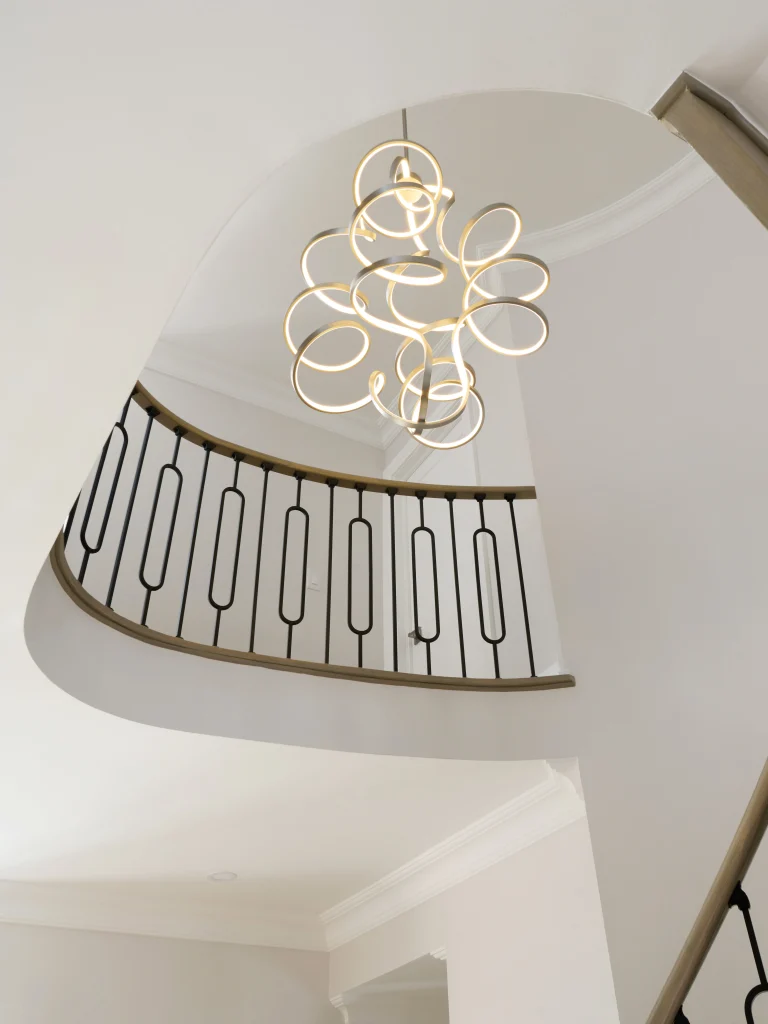
Layered lighting along three axes: task, ambient, and focal sculpture. A hand-blown glass pendant may act as dining-table centrepiece, while concealed LED coves graze plaster walls, revealing brushwork. Light guides attention, shaping daily rituals.
A bronze salt-sprayed pendant emits warm, weighted light, its surface slightly granular to the touch.
Smart drivers shift colour temperature from dawn to dusk, syncing circadian rhythms.
Shadow gradations play across ribbed walnut, turning a static wall into a kinetic installation.
Why It’s Investment-Grade
Dimmable, replaceable LED modules extend fixture lifespan.
Sculptural pieces double as art, reducing accessory purchases.
Energy savings accumulate. Most clients recoup fixture costs within four years.
Trend #8. Terracotta and the Comfort of Earth.
I remember the first time I visited a friend’s family courtyard in Foshan: sun-warmed terracotta tiles cooled feet just as thunderstorms released petrichor into the evening air. That primal earthiness is resurging.
Porcelain imitations lack the micro-porosity that modulates humidity, leaving rooms feeling static.
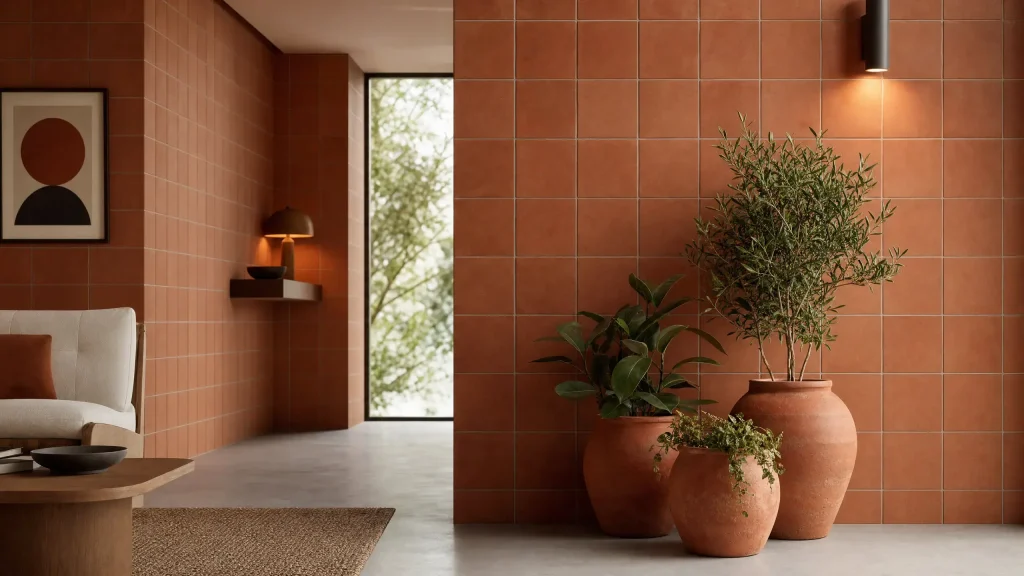
Hand-pressed terracotta tiles, sealed with breathable finish, regulate moisture while offering tonal depth. In a downtown loft, we paired them with radiant under-floor heat, turning a drafty industrial shell into an all-season sanctuary.
The tiles carry a faint mineral scent after mopping, grounding the kitchen’s stainless appliances.
Variations in firing temperature produce natural gradient – each tile a small artwork.
Walking barefoot reveals subtle temperature zones, connecting inhabitant to daily climate shifts.
Why It’s Investment-Grade
Thermal mass lowers heating and cooling bills.
Chips read as character, not defect. Individual tiles can be swapped without dye-lot headaches.
Artisanal production supports craft economies, a social dividend layered atop aesthetic return.
Trend #9. Tonal Layering.
Colour phobia leads homeowners back to white, still introducing many hues feels risky.
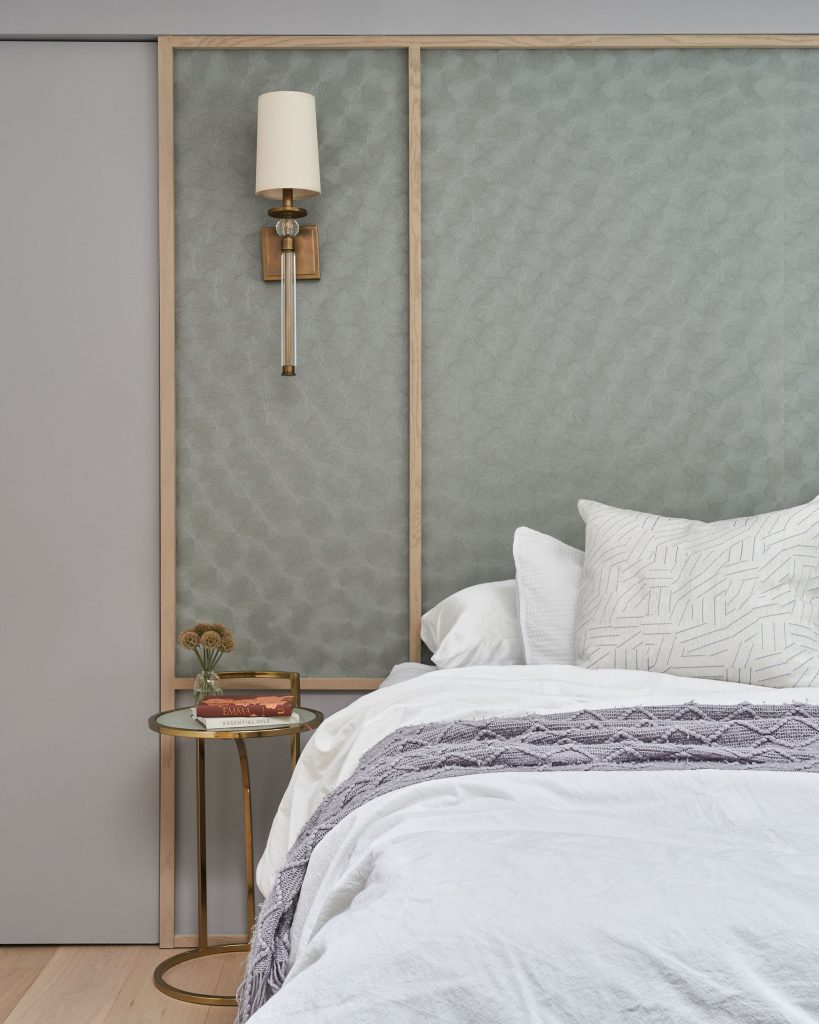
Select one hue family and modulate saturation. A primary bedroom might run the gamut from deep forest headboard upholstery to whisper-sage wall limewash to pale pistachio ceiling. The eye perceives variety. The psyche registers calm.
A wool-cashmere throw in a near-black green anchors the lighter bedding.
A single, pale jade ceramic lamp interrupts the gradient, adding quiet punctuation.
Why It’s Investment-Grade
New pieces slot into the tonal spectrum with ease, future-proofing decor updates.
Monochrome backdrops amplify artwork and personal memorabilia.
The timeless restraint outlives trend cycles, protecting renovation spend.
Trend #10. Biophilia 2.0
Token houseplants wilt, becoming clutter rather than comfort.
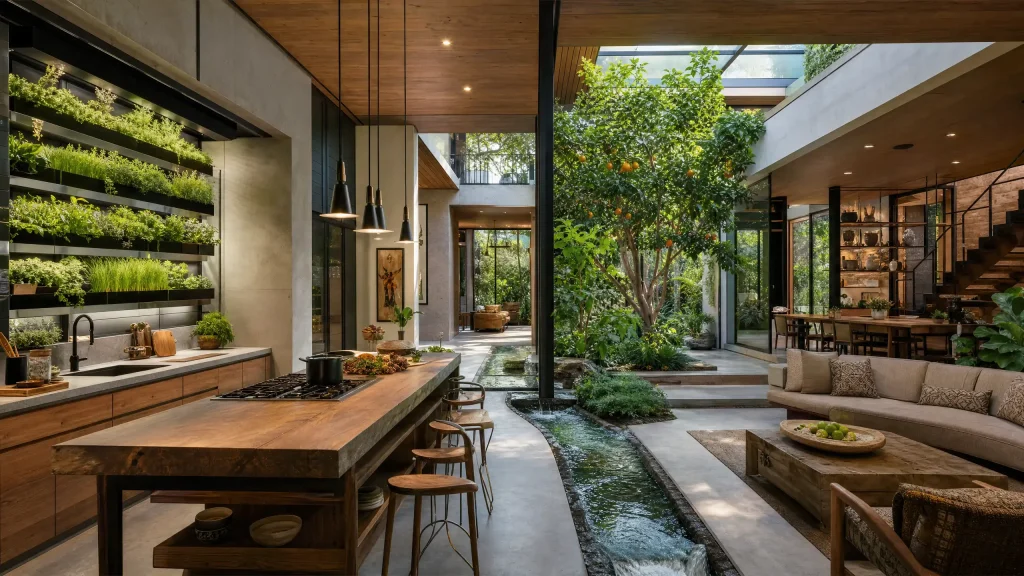
Embed nature into architecture: hydroponic herb walls adjacent to cooking zones, micro-orchard atriums lit by skylight wells, reclaimed-water rills threading indoor-outdoor thresholds.
Subtle humidity release softens winter air.
The faint hum of recirculating water masks city traffic.
Seasonal scent evolution – mint in summer, thyme in winter – cues appetite and memory.
Why It’s Investment-Grade
Studies show 8 – 12% property-value lift when substantial biophilic elements are present.
Indoor produce lowers grocery waste, an ecological and economic win.
Integrated systems qualify for green-building incentives, offsetting installation cost.
Trend #11. Silent Tech.
Devices multiply, visual noise escalates, and retrofit cabling mars carefully crafted finishes.
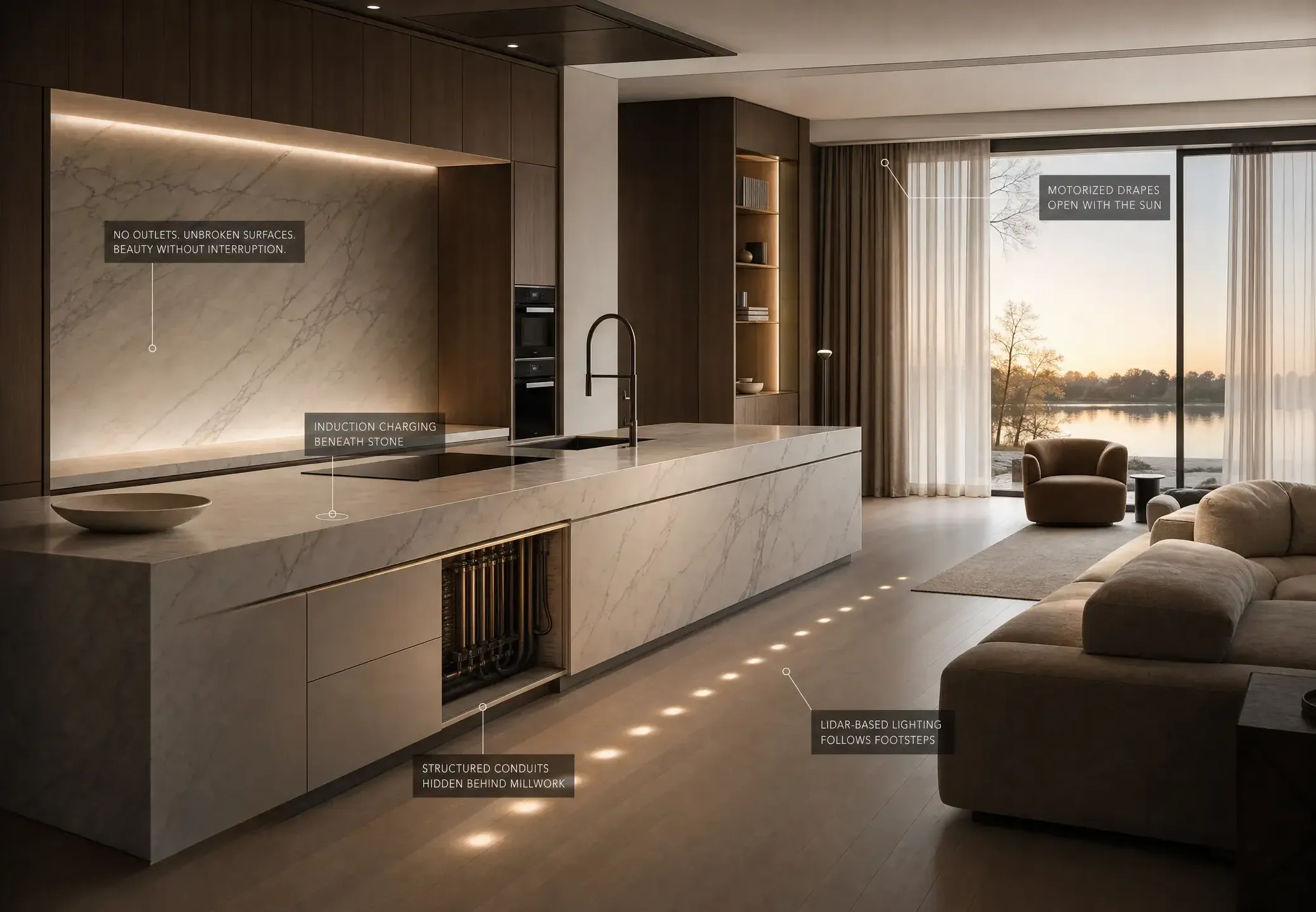
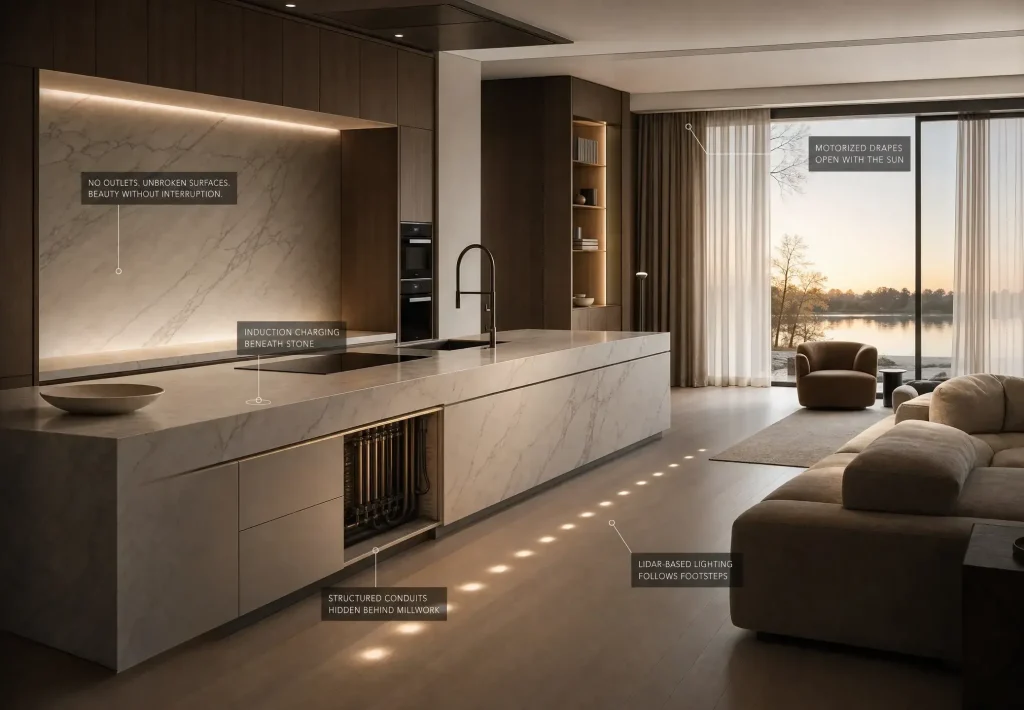
Plan technology the way one plans plumbing: invisibly essential. Structured conduits behind millwork, induction charging pads beneath stone, LIDAR-based lighting that follows footsteps.
Absence of outlets on splashbacks lets marble veining flow unbroken.
Soft motor whirr as drapes open at sunrise becomes an aural ritual.
Voice-controlled temperature shifts register only as changing air movement.
Why It’s Investment-Grade
Modular hubs allow upgrades without demolition.
Efficient zoning can reduce utility bills.
Technology’s retreat lets material investment shine, preserving design intent.
Trend #12. Sustainable Luxury.
“Green” often feels rustic or improvised, clashing with the refined environments my clients expect.
Specify materials that are both circular and sensorially rich: recycled-composite countertops with terrazzo sparkle, mushroom-based acoustic panels finished in Botticino plaster, cradle-to-cradle certified silk-wool rugs.
Mycelium panels emit a faint earthy aroma for the first weeks – a subtle grounding note.
Recycled-glass terrazzo refracts light like frozen confetti under pendant lighting.
Organic dyes in rugs oxidise over time, creating heirloom-worthy patina.
Why It’s Investment-Grade
Future regulations will penalise carbon-heavy materials. Early adoption sidesteps forced retrofits.
Many circular products qualify for tax credits or rebates, reducing net outlay.
Moral alignment amplifies daily satisfaction – design as a reflection of values.
Closing Notes
Trends seduce with novelty. Homes endure through resonance.
As you contemplate your own renovation or ground-up build, judge every potential “wow” against one quiet question: Will this choice still serve my life when the hashtag expires?
If the answer feels uncertain, keep walking the showroom floor. If it feels certain – if you can sense the weight of brass under fingertips, smell the warmth of terracotta after rain, hear the hush of integrated nature – then you have found a piece of the story only your home can tell.
And should you crave a partner fluent in narrative, enamoured with material juxtapositions, and stubbornly pragmatic about budgets, my studio door is open. Together, we’ll craft more than rooms. We’ll choreograph experiences that will, I hope, sing and dance for decades to come.
Frequently Asked Questions
Do specific interior design choices like maximizing views actually increase property value?
Yes, significantly. While aesthetics matter, the data on site orientation is compelling. Market analysis indicates that lakefront homes sold for ~127% higher than comparable inland properties. In our residential interior design trends 2026 strategies, we prioritize structural layouts that capture these vistas, ensuring your renovation capitalizes on the asset’s most lucrative feature.
How can interior design actively improve my physical health and recovery?
Your environment is a medical tool. Research shows that patients with nature views experienced substantially faster recovery times than those facing walls. We apply this science to master suites and relaxation zones, positioning them to reduce stress hormones and promote healing, transforming your home into a proactive wellness vessel.
What is the ‘Back Kitchen’ or ‘Scullery’ interior design trend?
The ‘Back Kitchen’ is the ultimate luxury for the consummate host. It is a fully functional prep space concealed behind millwork, housing messy appliances and dirty dishes. This allows your primary open-concept kitchen – often featuring sculptural islands and residential interior design trends 2026 finishes – to remain pristine during social gatherings, solving the anxiety of visual clutter.
How should I design a home office for maximum cognitive performance?
Treat it as a productivity engine, not a spare room. Given that productivity losses run about 112 times higher than energy costs, investing in acoustic isolation and circadian lighting is crucial. We design executive workspaces that mitigate distraction and fatigue, ensuring your home environment supports high-stakes decision-making.
Which color palettes are best suited for a calming, restorative home?
To combat burnout, clients are gravitating toward grounding hues. Studies on occupant comfort reveal a strong preference for neutral color palettes and natural materials like warm greys, browns, and blues. We utilize these tones to create a ‘psychological pause,’ designing spaces that feel physically soothing the moment you step inside.
What defines a ‘Healthy Home’ standard in modern luxury design?
It is the integration of active, breathable materials. For instance, we specify clay-based finishes because they rapidly buffer indoor humidity, outperforming standard gypsum. This creates a self-regulating ecosystem that protects respiratory health and artwork alike, proving that true luxury is biological compatibility.
Are dedicated wellness suites becoming a standard requirement?
Yes. The home gym has evolved into a holistic wellness suite. High-net-worth clients are requesting dedicated zones for infrared saunas, cold plunge pools, and meditation pods. This trend moves beyond fitness equipment to create a private spa experience, integrating daily self-care rituals directly into the architecture of the ‘forever home’.
How can I manage a complex renovation with a demanding career?
The key is engaging a full-service firm that acts as your advocate and project manager. Executing residential interior design trends – from smart infrastructure to custom joinery – requires rigorous coordination. We handle the procurement, trades, and timeline, allowing you to remain the visionary without becoming the supervisor.
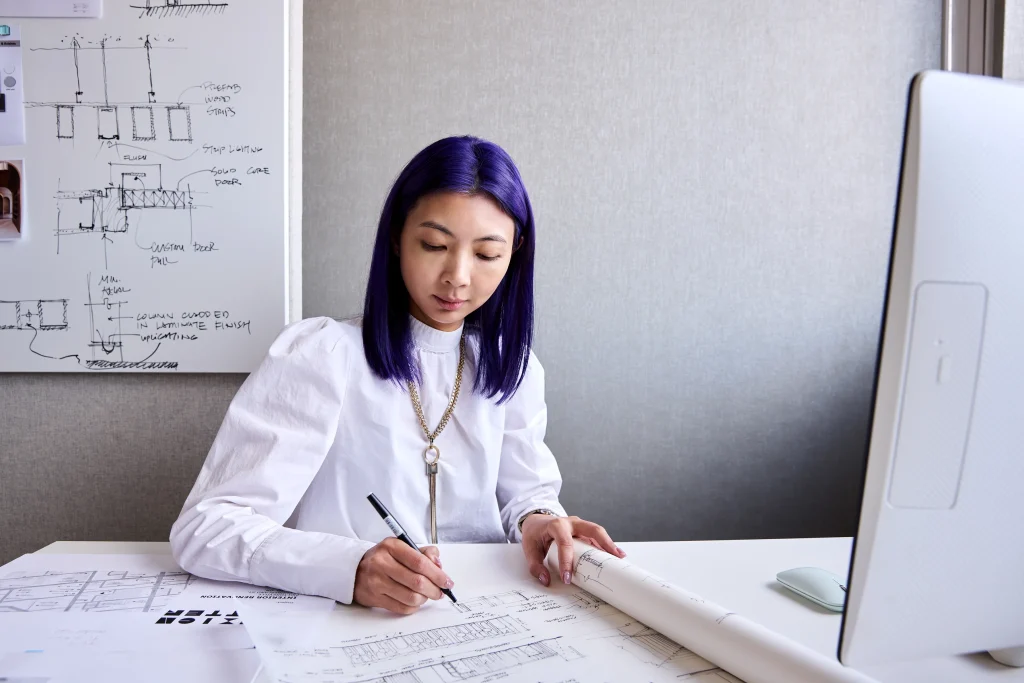
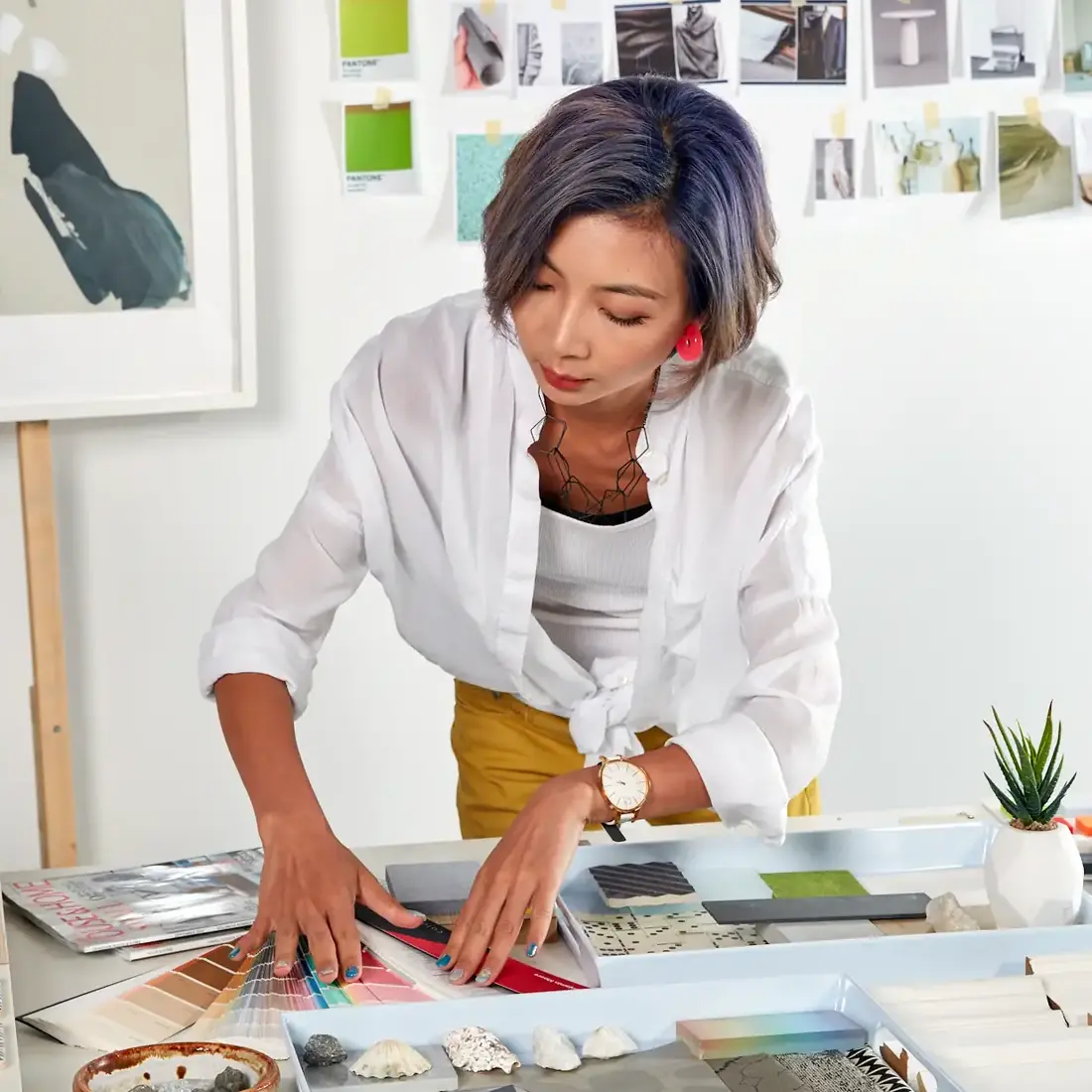
Zoe Lee, founder of Dexign Matter – where design meets storytelling. With over two decades of experience across North America and Asia, she crafts spaces that inspire and endure. Since 2003, Zoe has collaborated with global firms on iconic restaurants, luxury hotels, and refined residences. Each project reflects a pursuit of beauty, balance, and meaning.