You and I have never met, but I already know the exact instant when you decide whether a space deserves your loyalty – or your wallet. It’s that pause as you cross the entrance and take your first few steps. Architects worry about exits; marketers think about sales. But it all starts with that single heartbeat – where the floor greets your feet, a scent brings back a memory, and light paints a picture in your mind. Miss that first moment, and no clever loyalty plan can fix it.
Now, as Lead Designer at Dexign Matter, I’m still focused on that doorway moment. My work now includes large stores, stylish hotels, tech offices, and restaurants that are Instagram favorites. No matter the place, my job is clear: use design to turn business goals into spaces that sell your story.

Why Definitions Matter Less Than Outcomes
Ask five designers to define “commercial interior design” and you’ll collect five ornamental answers: it’s “the art of placemaking,” “the craft of experience,” or “the intersection of brand and environment.” Lovely phrases – yet none tell you how those words notch up revenue.
So let’s frame the problem first.
Problem:
- You have square footage that costs rent, payroll, and utilities every day.
- You have a brand story desperate for distinction in a scrolling economy.
- You cannot afford to let either asset idle.
Solution: Commercial interior design, when treated as strategic infrastructure, fuses those two needs. It sculpts air, light, texture, and flow so that every centimeter performs double duty: delighting the visitor and compounding your balance sheet. The result becomes your #1 business asset – measurable, defensible, and uniquely yours.
Everything that follows in this essay ladders up to that outcome.
The First-Impression Economy
Some call it “thin-slice judgment.” I call it monetized intuition. In seven seconds or fewer, a guest decides whether your restaurant feels worth a two-hour wait or your flagship store merits an Instagram Reel. That’s nothing more than the brain’s limbic system scanning for micro-clues: acoustic warmth, olfactory familiarity, ergonomic ease.
First impressions are not decor. They’re emotional acoustics, and they echo long after your guests head home.
Interior Design Perfected
Narrative: The Invisible Load-Bearing Wall
For me, developing a concept is like writing a script. You need a strong story before you choose the look or style. Understanding the client and aligning the narrative with the client’s preferences ensures the design is meaningful and effective. Otherwise, it’s just decoration with no meaning.
Here’s how Dexign Matter frames narrative as a solution to the common problem of generic space.
1. Discovery as Excavation.
Every brand holds its own hidden treasures—origin stories, emotional cues, customer rituals. Our role is to uncover them and turn them into spatial storytelling.
When we began the design journey with Charmed Aroma, a passing remark from their team stood out: many customers light their candles not just for fragrance, but for the ritual of reveal—the surprise jewelry hidden inside. That insight shaped our “Unboxing Moment” design concept: immersive product zones that mirror the anticipation, delight, and sensory richness of unwrapping a gift. It’s more than just product display—it’s a physical expression of Charmed Aroma’s emotional experience.

2. Conceptual Alchemy
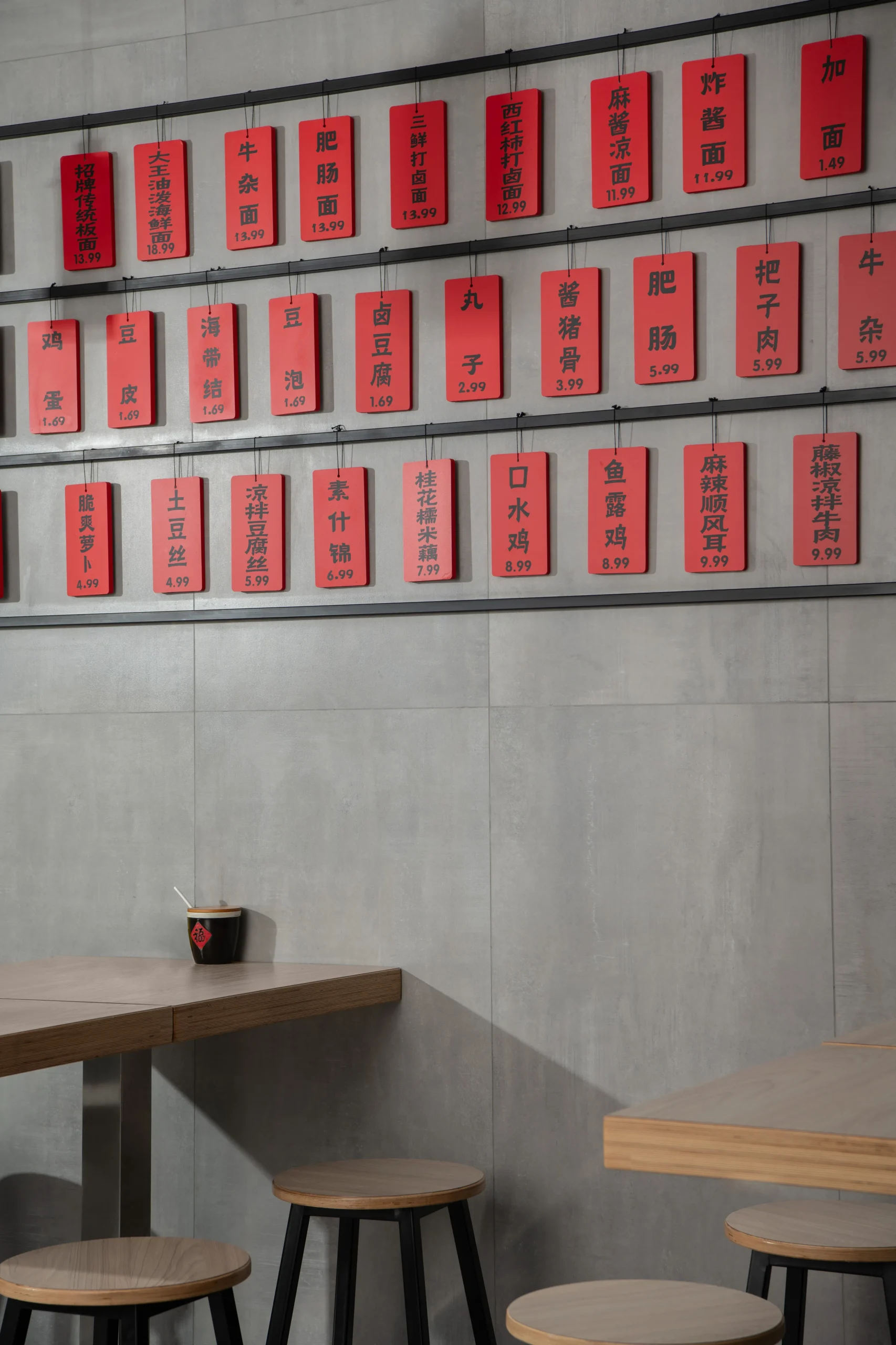
This stage is my favourite. We test-drive metaphors until one feels inevitable. For Noodle Legend, the concept that took hold was a fusion of nostalgic Asian night market energy with clean, contemporary minimalism. Picture raw concrete softened by light wood furniture, vibrant menu board punctuated by streamlined seating—an atmosphere that bridges the old world’s soul with the new city’s rhythm. It’s a balance of flavor and form, chaos and calm – just like the dishes served.
3. Technical Translation.
A powerful narrative is useless if it can’t survive sprinkler clearances or ADA lines-of-sight. We fold structural, mechanical, and code constraints into Revit models, guarding the story’s integrity.
Technical drawings are used alongside these models to communicate design intent and ensure all details are accurately translated into the construction process. Narrative is only as strong as its weakest detail.
4. Sensory Scoring.
Once the skeleton stands, we score the experience like a film composer layering strings, percussion, and vocals. Light becomes tempo, material palette becomes instrumentation, scent becomes melody.
When these layers conspire, a space crackles with the coherence you feel in a Michelin-starred tasting menu: every note different, yet every note in harmony.
Sensory Layering: Design You Can Taste
People assume the visual dominates, but smell is the only sense that connects directly to the brain’s memory center without a neural detour. That’s why a whisper of star flavour can yank you back to a childhood kitchen faster than any photograph.
Problem: Many commercial environments ignore multisensory cues, resulting in beautifully photographed spaces that feel eerily hollow in person.
Solution: We choreograph a five-sense symphony.
- Sight: Directional lighting sculpts merchandise, but it also guides wayfinding subconsciously.
- Sound: Low-frequency hum softens glassy surfaces; high-frequency “sparkle” energizes a bar at 9 p.m.
- Smell: In a boutique spa we designed, a cedar-cypress accord greets guests upon entry, aligning with the brand’s forest-bathing ethos.
- Touch: Natural linen on banquette backs invites lingering; cold steel on a café countertop accelerates turnover, perfect for commuters.
- Taste: Yes, taste. Complimentary micro-tastings at a winery retail zone prime customers for higher bottle spend. That is a spatial strategy disguised as hospitality.
The goal is deliberate contrast – rough against silk, hush against clink – because juxtaposition makes the brain attend. When attention sharpens, brand memory takes root.

Space as Calculator: Crunching the RODI
Return on Design Investment (RODI) is the metric I reference when CFOs raise an eyebrow at artisan-plastered vaults or bespoke terrazzo.
Let’s ground RODI in hypothetical scenarios. Defining the project’s scope is essential for measuring outcomes and ensuring all design objectives are met.
Specialty Coffee Chain - Suburban Location
Problem: Declining afternoon traffic and shortened customer visits.
Solution: Optimized layout with modular seating configurations, charging stations integrated into communal tables, and acoustic zoning for work-friendly areas improved customer flow and encouraged longer visits.
Outcome: $425 → $640 sales per square foot; average visit duration increased 35%; payback in fourteen months.
Corporate Wellness Center - Business District
Problem: Low employee utilization despite company investment in facility.
Solution: Intuitive wayfinding system, flexible multi-use spaces, circadian lighting that adjusts throughout the day.
Outcome: Daily usage up 180%, employee satisfaction scores increased 2.3 points, reduced healthcare claims saving $120K annually.
Regional Bank Branch - Mid-sized City
Problem: Customers avoiding in-person visits, preferring digital channels.
Solution: Open consultation pods replacing traditional teller barriers, interactive financial planning stations, comfortable waiting areas with refreshment counter and local art.
Outcome: Face-to-face appointments up 45%, new account openings increased 28%, customer Net Promoter Score improved from 6.2 to 8.1.
If numbers soothe you more than adjectives, remember: a well-crafted chair is lovely, but a well-crafted metric earns seats at the board table.

Versatility Without Dilution
One question prospective clients ask me: “Your portfolio hops from cocktail bars to co-working lofts to medical spas – how can one firm know them all?” My answer is simple: Human behaviour is our common denominator.
Hospitals seek calm, hotels seek allure, offices seek focus, but every project ultimately navigates how bodies move, how conversations flow, how memories embed. By anchoring design decisions in behavioural science, we scale horizontally across sectors without sacrificing depth.
Wen Li, a serial investor who has partnered with Dexign Matter on both residential and commercial ventures, summarized it better than I could:
“Dexign Matter Studio is one of the best interior design in Canada. Their top designer Zoe Lee with 20+ years experience, always create a lot of luxury, unique and elegant design. With their detail discussion, conclusion and follow up. The investor can be 100% assure to pass the interior renovation to them without any worries and hidden. For my next residential and business project, I definitely will choose Dexign Matter Studio.”
Confidence like that isn’t purchased; it’s accrued through cross-sector fluency.
Stay Informed on Interior Design Trends
Get our interior design insights right in your inbox.
Common Mistakes of Commercial Design That Quietly Drain Profit
Let’s toggle back to the problem/solution framework.
- Myth: “Open plan equals collaboration.” Problem: Acoustic chaos and privacy erosion. Solution: Nested zones – an inner sanctum for focus, an intermediate ring for small huddles, an outer ring for social buzz – linked by visual transparency, not auditory free-for-all.
- Myth: “Lighting is where we can save money.” Problem: CRI-poor fixtures distort merchandise colors, eroding perceived quality. Solution: Layered lighting with >90 CRI LEDs, circadian programming for staff wellness, accent spots calibrated to product margins.
- Myth: “Furniture is fungible.” Problem: Inconsistent ergonomics and accelerated wear. Solution: Furnishings specified for duty cycle, anthropometrics, and brand narrative. Custom millwork when the mass market softens the story’s edge.
Each myth masquerades as frugality; each becomes expensive in hindsight. Cutting corners at the concept stage only builds a maze of hidden costs – maintenance, staff turnover, rebranding – down the line.
Invitations, Not Conclusions
Instead of a conclusion, let me pose a final problem:
You have aspirations bigger than the square footage you occupy. You need that space to fight above its weight class, to serve as billboard, brand ambassador, and balance-sheet warrior – all at once.
And here’s my open-ended solution:
Invite me into your design challenge the way you’d invite a chef into your empty restaurant shell. We’ll taste the air, interrogate the numbers, and draft a narrative spine so taut it can carry the full weight of your ambition. Then we’ll layer materials until the walls hum, dial the lighting until the product glows, and tune the acoustics until conversations find their cadence.
The doorway moment is waiting. Let’s craft it so deftly that customers cross the threshold and feel – before they can name the feeling – that they’ve arrived somewhere meant precisely for them.
Frequently Asked Questions
What is commercial interior design and how is it different from residential interior design?
Commercial interior design focuses on attracting customers and generating revenue through strategic market-aligned decisions, while residential interior design prioritizes homeowner happiness and lifestyle enhancement. Commercial spaces emphasize objective business outcomes - how many people will spend money, what the market demands. Residential design is subjective, requiring a deep understanding of clients' professions, daily habits, and lifestyle preferences to create people-centered spaces that improve quality of life.
What types of commercial spaces do commercial interior designers typically work on?
Commercial interior designers create spaces for retail stores, healthcare facilities, government buildings, public spaces, and various business environments. Each commercial space requires understanding different departments' functional requirements, building codes, and client's budget constraints. From patient comfort in healthcare facilities to product display optimization in retail space, commercial designers adapt their approach to enable people to thrive in diverse commercial interiors.
What business outcomes do commercial interior designers focus on for retail stores and commercial spaces?
Commercial interior designers prioritize measurable business outcomes: attracting customers who will spend money, enhancing brand identity, and aligning with market demands. We ask "how much business can our design bring?" rather than focusing solely on aesthetic appeal. Strategic product display, customer flow optimization, and creating visually appealing spaces that drive revenue are key. Commercial design success is measured by business productivity and customer attraction rather than personal preferences.
How do commercial interior designers make strategic market-driven decisions?
Commercial interior designers analyze market demands to recommend strategic decisions that maximize business potential. Unlike residential interior design which emphasizes personalization, commercial design is objective - focusing on what attracts customers and generates revenue. We study target demographics, competitor spaces, and industry trends to create commercial interiors that align with market expectations while maintaining brand identity and ensuring the space attracts people to spend money.
How do commercial interior designers balance aesthetics with business functionality?
Commercial interior designers create visually appealing spaces while prioritizing business outcomes over pure aesthetics. Quality isn't judged solely by materials or craftsmanship, but by revenue generation potential. We design commercial spaces that attract customers, optimize product display, and enhance customer experience while maintaining brand identity. The goal is creating functional, beautiful environments that serve business objectives and enable people to engage with the brand meaningfully.
What market research do commercial interior designers conduct before creating initial design concepts?
Commercial interior designers research target demographics, competitor analysis, and industry trends before developing initial design concepts. We study what attracts customers in specific commercial spaces, analyze successful retail stores or healthcare facilities, and understand market demands. This objective approach ensures our people-centered design aligns with business goals, attracts the right clientele, and creates commercial interiors that generate revenue while serving user needs effectively.
What role does brand image play in commercial interior design projects?
Brand image is crucial in commercial interior design as it transforms commercial space into powerful brand ambassadors. Commercial interior designers integrate brand image through color schemes, design elements, and architectural details that create visually appealing spaces. Unlike residential interior design, commercial design must reinforce business identity while ensuring customer experience aligns with brand values, ultimately supporting business productivity and revenue generation goals.
How do building codes and regulations impact commercial interior design projects?
Building codes significantly influence commercial interior design, requiring designers to navigate complex regulations for healthcare facilities, education centers, and public spaces. Commercial interior designers must ensure compliance while maintaining aesthetic appeal and functional requirements. The construction process involves construction administration phases where designers coordinate with different departments to ensure project completion meets all regulatory standards while achieving the client's vision.