Design cannot begin and end with form and finish. To turn square footage into a genuine business asset, we must choreograph the invisible currents that shape behaviour. The language I use for that choreography is Feng Shui.
I have seen too many visionary business owners invest millions in lighting, terrazzo, and social-media moments only to discover the space itself is indifferent – or, worse, hostile – to their commercial goals. It doesn’t have to be this way. When energy, story, and strategy are woven together, a store sells harder, a hotel lingers longer on the guest’s skin, and a co-working lounge quietly recruits top talent by sheer magnetic pull.
The Core Problem: “Pretty” Is Not the Same as “Performing”
Stand on any high street and you’ll see it: eye-catching facades, LED halos, a veneer of wow. The average visitor offers an approving nod, maybe an Instagram snap, but in three minutes they drift away. Retail conversion rates sag, hospitality check sizes plateau, employees dream of somewhere quieter, lighter, kinder.
Why does that happen? Because most design briefs begin with the visible: colour palettes, brand fonts, hero fixtures. The intangible – air velocity at the threshold, acoustic pressure in the bar area, psychological safety behind the reception desk – rarely makes it past value-engineering. The result is a space that photographs brilliantly still underperforms in every metric that matters to your P&L.
Before I sketch partitions or specify marble, I ask a single question: What behaviour must this environment inspire if the business is to flourish? From that answer flows a living narrative – an emotional blueprint. Feng Shui gives me the analytical framework to translate narrative into placement, circulation, elemental balance, and micro-climate. The aesthetic choices then become inevitable, not ornamental. In other words, we design from the inside out.
Feng Shui, Decoded for the Modern Entrepreneur
Misconceptions abound, so let me anchor the term in straightforward language. Feng Shui – literally “wind” and “water” – examines how built form directs life-force energy, or Qi. If that feels esoteric, replace Qi with human vitality. Good Feng Shui positions walls, openings, and materials so that vitality is invited to linger where it adds value and to accelerate where momentum is needed.
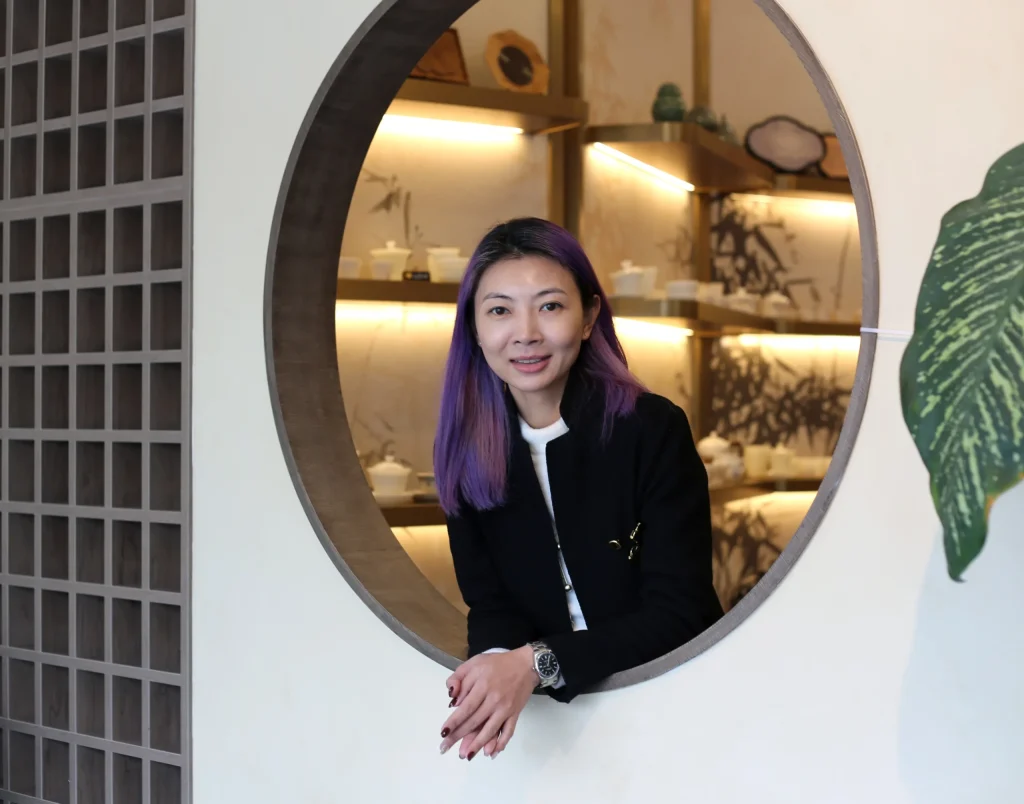
I was raised between GuangDong’s centuries-old courtyards and Shanghai’s hyper-modern skyline. From elders I inherited respect for placement. From global practice I inherited the rigour of building codes and spreadsheets. Today, when I guide a founder through Feng Shui interior design, I present it in three practical layers:
Form: the tangible geometry that immediately shapes flow.
Orientation: the magnetic alignment that subtly influences physiology.
Time: the way energy migrates through cycles. Think of it as seasonality, only more precise.
90% of commercial uplift happens once we master the first layer, so that is where we begin.
6 Spatial Choreographies That Shift the Bottom Line
Not style for its own sake.
1. Set the Tone Before a Word Is Spoken.
Too many entrances feel like border checkpoints. Customers brace themselves rather than relax.
Recess the door just enough to create a pressure equalisation pocket. In Feng Shui we call this the Bright Hall – a pause where the external rush can settle.
2. Command Position.
Staff stationed with their backs to entries or circulation feel exposed. Cortisol rises. Service quality falls.
Angle the cash desk or bar so that teams see incoming guests while retaining a solid wall behind them. Command is not about dominance. It is about calm authority that guests intuitively trust.
3. The Golden Path.
Straight, monotone aisles accelerate traffic. Shoppers speed through without engaging in merchandising.
Modulate width, light, and texture as if composing a piece of music: a narrow wood-inlay section that creaks softly underfoot, opening to a generous terrazzo bay where fragrances bloom.
4. Elemental Harmony.
Single-note finishes, no matter how luxurious, tire the senses.
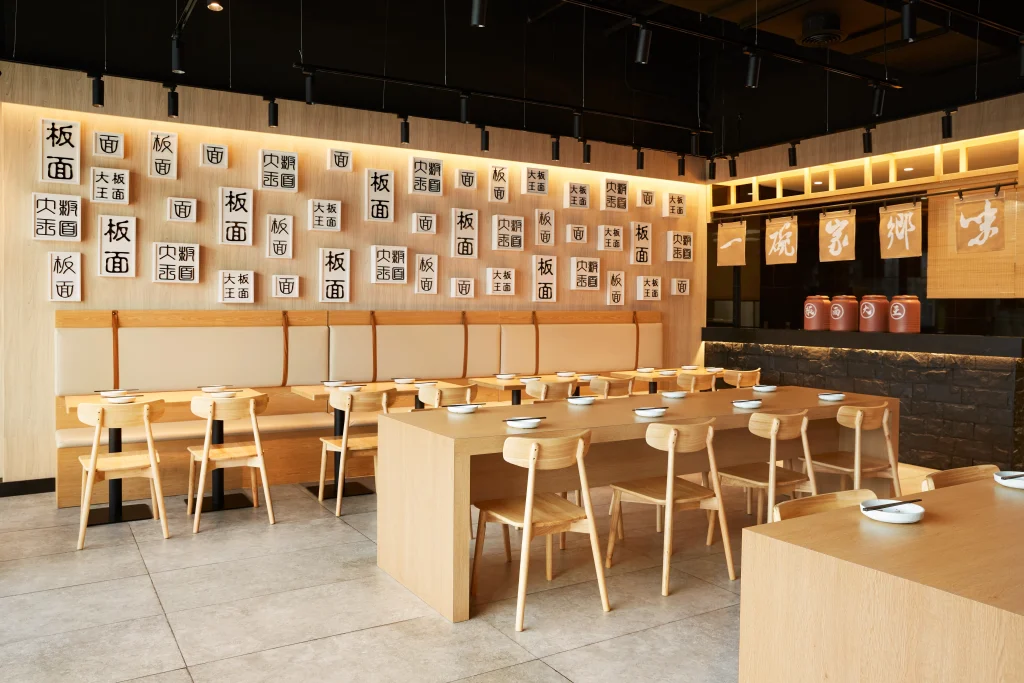
Weave the Five Elements – Wood, Fire, Earth, Metal, Water – into a sensory sequence. Metal’s precision in a brushed-aluminium fixture. Earth’s stability in rammed-clay wall niches. Water’s ease in a tempered glass bar top that catches the light like a slow river. Clients may not name the elements, but they feel the completeness.
5. Light and Air.
Poor air exchange and static lighting drain both shoppers and staff before the second cappuccino.
We specify MERV-13 filtration and tunable LEDs that shift from cool welcome at 9 a.m. to warm embrace at dusk. Traditional Feng Shui simply recognised that fresh, living air is a must.
6. Acoustic Containment.
Reverberation over 0.8 seconds triggers fatigue. Conversation scatters.
Treat ceilings with micro-perforated timber, line bookshelves with felt, disguise white-noise fountains as art.
4-Stage Feng Shui Process
Step 1: Discovery.
I arrive on site with a Luo Pan compass and a blank notebook – tech comes later. We walk, we listen, we ask:
Where does morning sun strike?
Where does the floor vibrate under subway lines?
Just as an oncologist studies scans before prescribing, a designer must read a building’s energy signature before decorating symptoms.
Step 2: Concept Development.
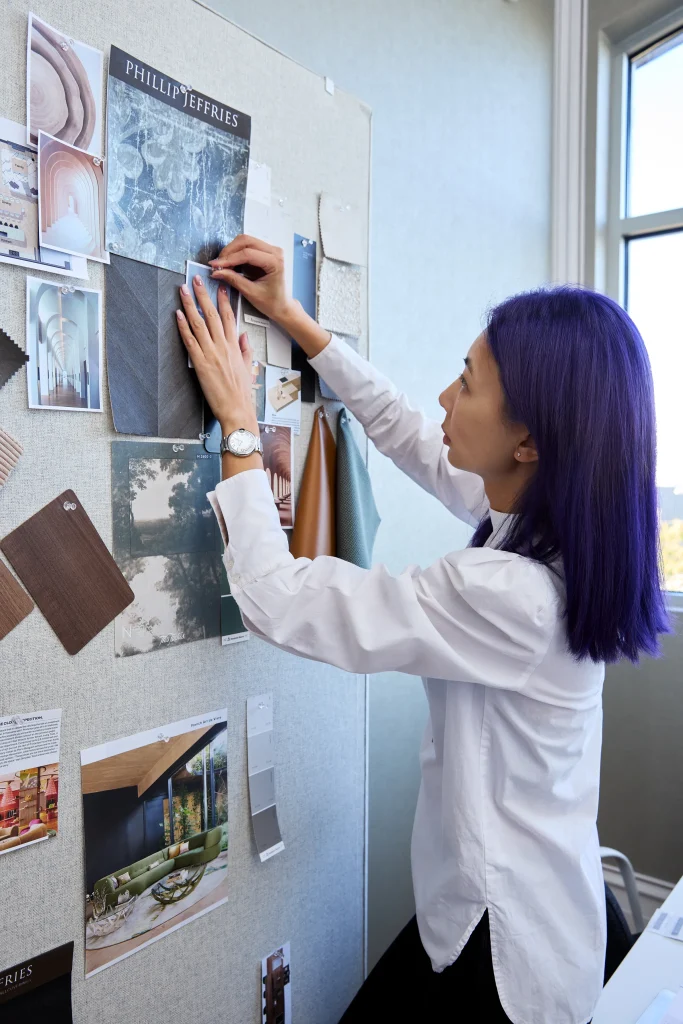
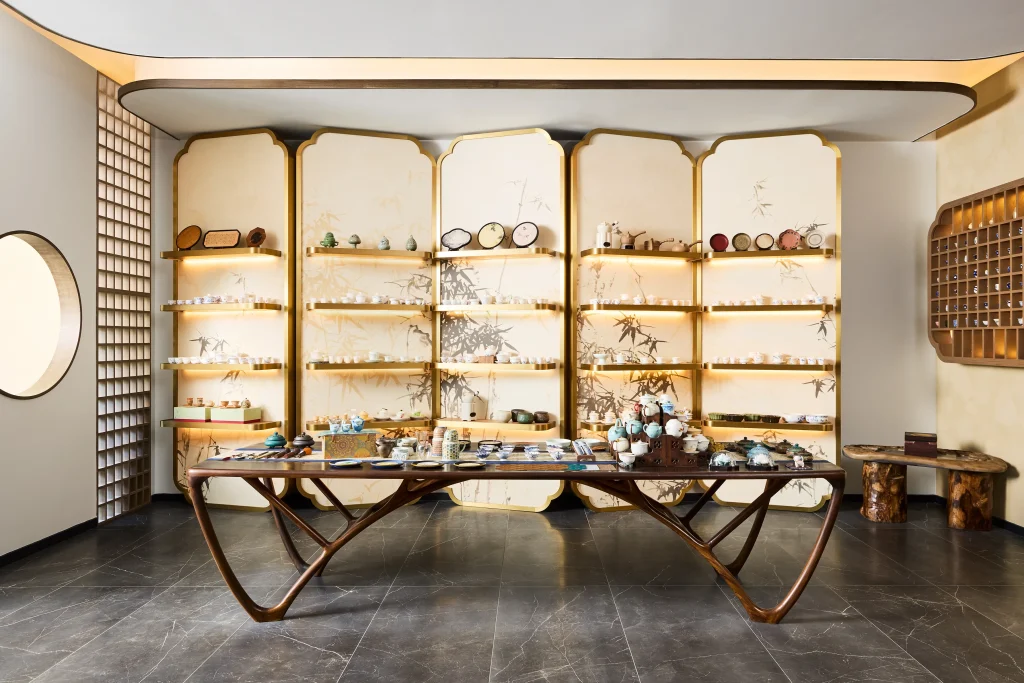
This is the moment many interior design firms treat as a mood-board exercise. For me, it is blueprint and manifesto in one. Together we articulate a sentence that will steer every detail: “An Urban Oasis of Electrified Serenity,” or “The Neo-Artisan Forge.” During the Brewin Teaware commission, that guiding sentence saved us from expensive distractions. Every vendor decision either served the enchantment or was edited out.
Step 3: Macro Planning.
Now it’s time for BIM and spreadsheets. We lay Feng Shui grids over fire-egress routes, cross-check against local codes, model customer flow. If Qi arrives too fast, what fixture slows it? If Flying-Star cycles predict a shift in the prosperity sector five years out, where should future shelving be modular?
Step 4: Sensory Layering.
Remember the feeling of brushing your palm across linen after ice? That is juxtaposition – my favourite design instrument.
For example, in a tech R&D hub you can embed moss panels (Wood) beside carbon-fibre boards (Metal), backlit by programmable LED flames (Fire). Creativity thrives where senses are stimulated coherently.
Let Your Space Earn While You Sleep
I began with a boutique that looked impeccable still performed indifferently. Since that night on the sales floor, I have approached every project – whether a 5-star hotel or a pop-up cafe – with the conviction that space is not a backdrop but an active partner in profit.
If you, ambitious reader, are plotting a flagship, a headquarters, or a hospitality jewel, I invite you to go beyond aesthetics. Let’s choreograph the unseen currents so that walls, lights, and even the air itself conspire in your favour. Your brand story will not simply be told. It will be felt – viscerally, memorably, repeatedly – by every guest who crosses the threshold.
I’m ready when you are. My compass is packed, the blank notebook waiting. Shall we begin?
Connect with me directly at info@dexignmatter.com
FAQs
Can we apply Feng Shui principles to an existing office without a full renovation?
Absolutely. We often refer to this as ‘spatial acupuncture.’ You do not always need to tear down walls to shift the energy. Strategic adjustments – such as repositioning key desks into the command position, altering the lighting temperature to match circadian rhythms, or introducing specific elemental materials – can significantly improve flow. These targeted applications of Feng Shui principles allow you to optimize your current asset for better focus and morale with minimal disruption to operations.
How does integrating live plants affect commercial ROI beyond aesthetics?
While greenery softens a stark modern aesthetic, its functional impact is measurable. In Feng Shui, healthy plants introduce vital ‘Wood’ energy, which governs growth and upward momentum. This aligns with data showing that offices with substantial plant life generate a 15% employee productivity boost. By strategically placing living elements, we not only balance the space energetically but also drive tangible output and staff satisfaction.
What are the biggest ‘red flags’ to look for when scouting a new commercial location?
Before signing a lease, evaluate the external environment for ‘Sha Qi’ or attacking energy. Avoid locations facing a T-junction (where oncoming traffic rushes directly at the door) or buildings overshadowed by sharp, aggressive structures that point toward your entrance. These external features can create a subconscious sense of threat for customers and staff. Good Feng Shui principles suggest choosing a site with a supportive ‘backing’ structure and an open, welcoming frontage to accumulate positive Qi.
Can invisible factors like air quality actually impact my team’s strategic performance?
Yes, and the correlation is stark. In Feng Shui, Qi is synonymous with breath and vitality; stagnant air equals stagnant business. Modern research supports this ancient wisdom: studies indicate that professionals score 61% higher on cognitive tests in environments with optimized ventilation and low VOCs. Prioritizing air quality is not just a wellness perk – it is a strategic imperative for maintaining high-level decision-making capabilities.
How do we handle open-plan offices that feel chaotic and distracting?
Open plans often suffer from a lack of ‘containment,’ causing energy (and attention) to scatter. We apply Feng Shui principles to introduce ‘mountains’ – vertical elements like high-backed acoustic furniture, storage units, or partitions – that provide psychological protection and privacy. By zoning the space to separate high-activity ‘Yang’ areas from deep-focus ‘Yin’ zones, we reduce visual noise and help employees feel anchored, which significantly lowers stress and improves retention.
What if my brand colors conflict with the elemental balance the space needs?
Brand identity and energetic balance can coexist without clashing. If your brand color is red (Fire) but the sector needs calm (Water), we don’t paint the walls blue. Instead, we introduce the Water element through shapes (wavy lines), materials (glass or mirrors), or actual water features. Feng Shui principles are about the essence of the element, not just the pigment. This allows us to maintain strict brand guidelines while subtly correcting the energetic imbalances of the physical space.
How can spatial layout influence the outcome of high-stakes board meetings?
The geometry of a meeting room dictates the power dynamic. A long rectangular table reinforces hierarchy but can stifle collaboration. For creative strategy, a round or oval table facilitates the flow of ideas. Crucially, the chairperson must sit in the ‘power position’ – facing the door with a solid wall behind them – to command the room effectively. Applying these Feng Shui principles ensures that the environment supports your negotiation goals rather than subtly undermining your authority.
Why is the indoor environment considered a critical determinant of business health?
We often underestimate the impact of our surroundings, yet we spend roughly 90% of our time indoors. Your commercial space is the container for your company’s culture and performance. If that container is toxic or energetically blocked, it acts as a constant drag on efficiency. By optimizing the built environment, you are directly investing in the biological and psychological baseline of your workforce, turning the space itself into a performance-enhancing asset.
How do we manage heavy technology infrastructure without disrupting the flow of Qi?
Visible tangles of cables and servers generate ‘electrosmog’ and visual chaos, which disrupts mental clarity. From a design perspective, we treat technology as a strong ‘Fire’ element that needs containment. We use custom joinery to conceal wires and balance the excess heat with ‘Earth’ materials like stone or ceramics to ground the energy. Proper cable management is not just tidy; it adheres to Feng Shui principles by reducing subconscious stress triggers in the workspace.
Is there a specific ‘wealth corner’ in commercial spaces that we should prioritize?
While the southeast sector is traditionally associated with wealth, commercial Feng Shui is more dynamic. We look for the ‘Water Star’ location based on the building’s specific age and orientation. This is the energetic sweet spot for revenue generation. We typically activate this zone with movement – such as a main entrance, a busy reception, or an active water feature – to stimulate the flow of prosperity. Ignoring this sector is often a missed opportunity for organic growth.