If we were sitting together in my Toronto studio, I’d begin with oolong tea – the kind my grandfather kept in lacquered tins in Guangzhou – and I’d invite you to rest your palms on the table while we talk. I want you to feel how warmth from the porcelain travels into your fingertips. That small transfer of energy is where every project starts for me: a quiet, almost invisible exchange that shapes how we breathe, think, and move.
20 years of designing hotels, boutiques, and private homes have taught me that luxury is never just a price point or a provenance stamp. True luxury is that moment when a space settles the nerves and releases the shoulders – exactly what the tea is doing right now.
Feng Shui interior design gives language and structure to that sensation. It is the conceptual backbone that turns an opulent but restless room into a sanctuary with purpose and poise.
The #1 Interior Design Problem: Beautiful Still Restless Rooms
Almost every prospective client arrives with the same underlying frustration, even if they describe it in different ways:
“I invested in Calacatta marble, but the kitchen feels sterile.”
“My penthouse has the skyline view, but guests never never want to stay long.”
“I own art museums court, and still the living room feels flat.”
The materials are impeccable, the budget generous, and the craftsmanship sound, but the space will not settle for some reason. Something is missing, and they can’t name it. That “something” is exactly the kind of design problem I love to solve, because it lives at the intersection of function, emotion, and narrative.
How I First Met Feng Shui
As a child in Guangdong, I watched my grandmother slide the mah-jong table a handspan west every Spring Festival. She never spoke of Chi, but I could feel the house brighten after she finished. Years later, sketching a boutique at Kokai Studio, I caught myself shifting a gondola by precisely the same handspan to open a diagonal view. My colleagues saw an aesthetic tweak. I felt an energetic one. Only then did I begin formal study of Feng Shui, and I realized it was not superstition at all but an architectural psychology refined over millennia.
Chi
Chi is the current that meanders through a plan like a river in slow motion. When it pools, we feel stagnation. When it rushes, we feel uneasy. My job is to grade the riverbed – widening some passages, softening others – so the flow feels effortless.
Yin and Yang
Luxury clients often collect dramatic pieces – onyx fireplaces, kinetic chandeliers, monumental art. An all-star ensemble can still clash if every voice is mezzo-forte. Balancing Yin (repose) and Yang (dynamism) is like orchestrating a symphony: the pause between notes is as critical as the crescendo.
The Five Elements and the Bagua
Wood, Fire, Earth, Metal, Water – five simple words that, when translated into texture and tone, create an emotional topography more layered than any Pantone deck. Maple slats invite expansion (Wood), a flicker of antique bronze anchors legacy (Metal), while honed travertine soothes (Earth). Overlay that with the Bagua, a grid linking parts of the plan to aspects of life – wealth, health, creativity – and decisions shift from arbitrary to intentional.
My Feng Shui Interior Design Process
This is the method I use to translate Feng Shui into tangible interiors:
Step 1: Listen for Undercurrents.
Before I draft, I listen. I want to know where your dog naps at 3 p.m. and which window you stand by when you phone your mother. These anecdotes reveal existing energy flows more reliably than any tool can measure.
Step 2: Map the Invisible.
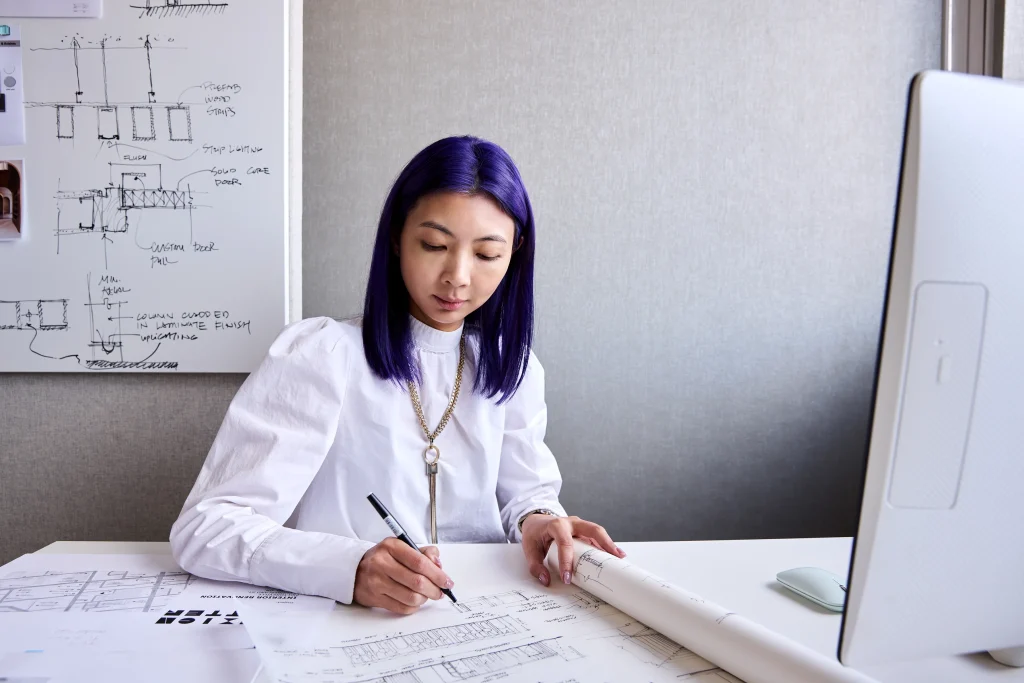
I draw two plans: one with load-bearing walls and ductwork, another with the Luo Pan. Where they conflict, the balancing act begins. Will a steel beam free the commanding view for your home office? That decision sits beside appliance specs on my spreadsheet – equal weight, no mystique.
Step 3: Write the Narrative.
Every project receives a single-sentence concept. For the Brewin Teaware showroom it was, “A river of stories carving curiosity into calm.” That line guided every move, from the sinuous display layout to the handcrafted solid wood table that mimicked falling leaves in the forest.
Step 4: Craft the Sensory Palette.
I curate materials like casting actors. A matte plaster wall might read shy until you cast it opposite a polished brass screen, and suddenly both surfaces sing. When all five elements appear in proportion, the room gains resonance – as though the color palette has a basso continuo you can’t quite hear still can certainly feel.
Step 5: Choreograph Execution.
True luxury is logistical ballet. A 600-pound marble island must land after the wide-plank floors acclimate, or micro-cracks bloom later. Likewise, a pendant misaligned by two centimeters will topple the commanding position of the dining table. Guardianship during installation is non-negotiable. I treat Chi like an honored guest who deserves a clear runway.
How Feng Shui Elevates Interior Luxury
Well-Being: Bedrooms oriented with supportive compass directions correlate with deeper REM cycles. Clients track this on their Oura rings. I read it in their faces.
Cognitive Ease: When a study positions the desk to face the door – commanding position – executives report reduced decision fatigue.
Asset Value: Properties marketed as Feng Shui-compliant in Vancouver and Hong Kong secure 2-5% premiums.
Brand Loyalty: Retail environments that flow keep customers longer. Charmed Aroma’s dwell time rose nine minutes post-renovation, translating directly into sales.
A Sensory Walk-Through: Juxtaposition in Action
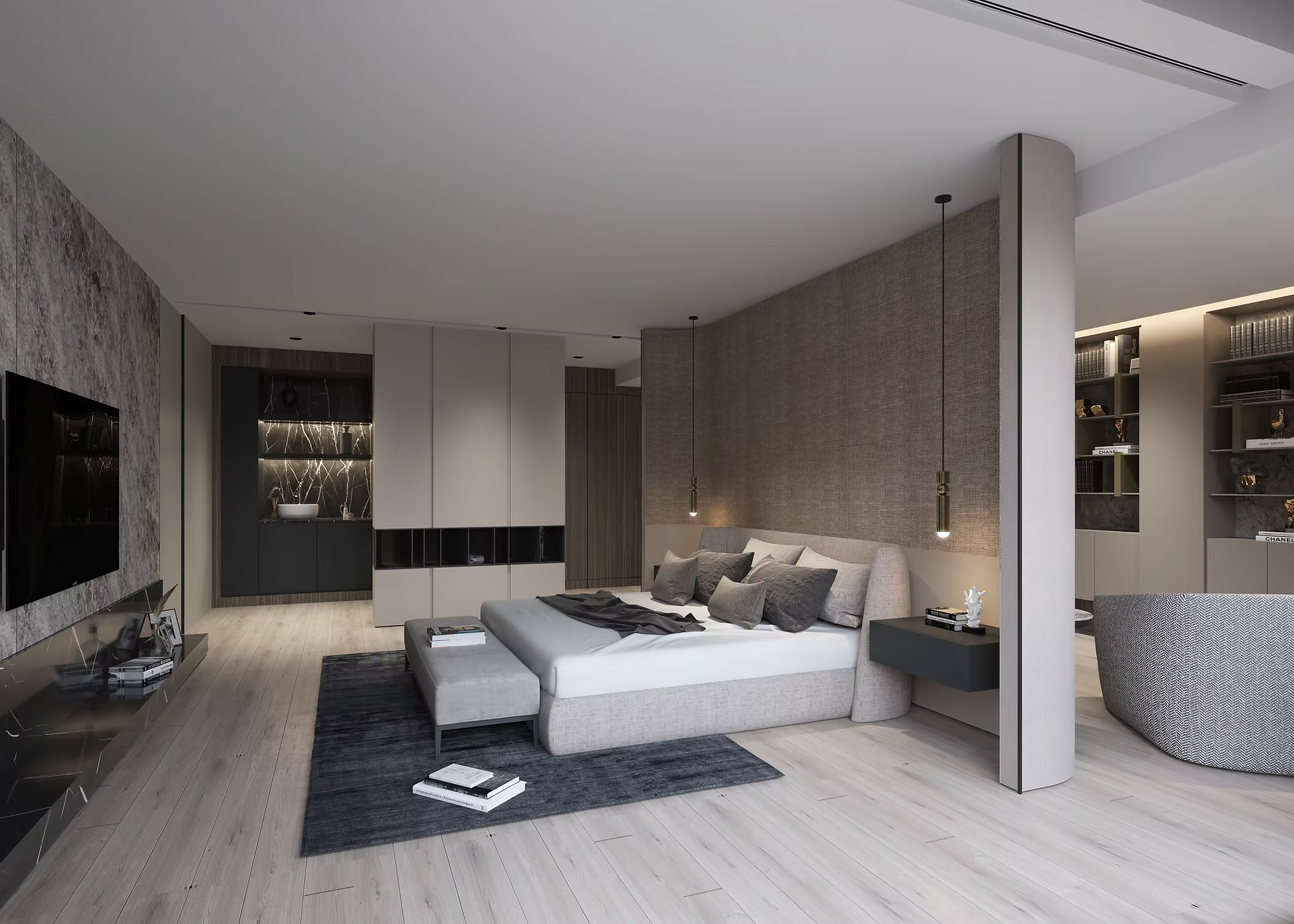
Let’s return to the penthouse’s great room. Under bare concrete and ductwork it felt like an airplane hangar – acoustically harsh, emotionally hollow. The design problem is scale without intimacy. Here’s my solution:
Form: A sculpted ceiling plane dips subtly over the seating cluster, lowering the perceived height.
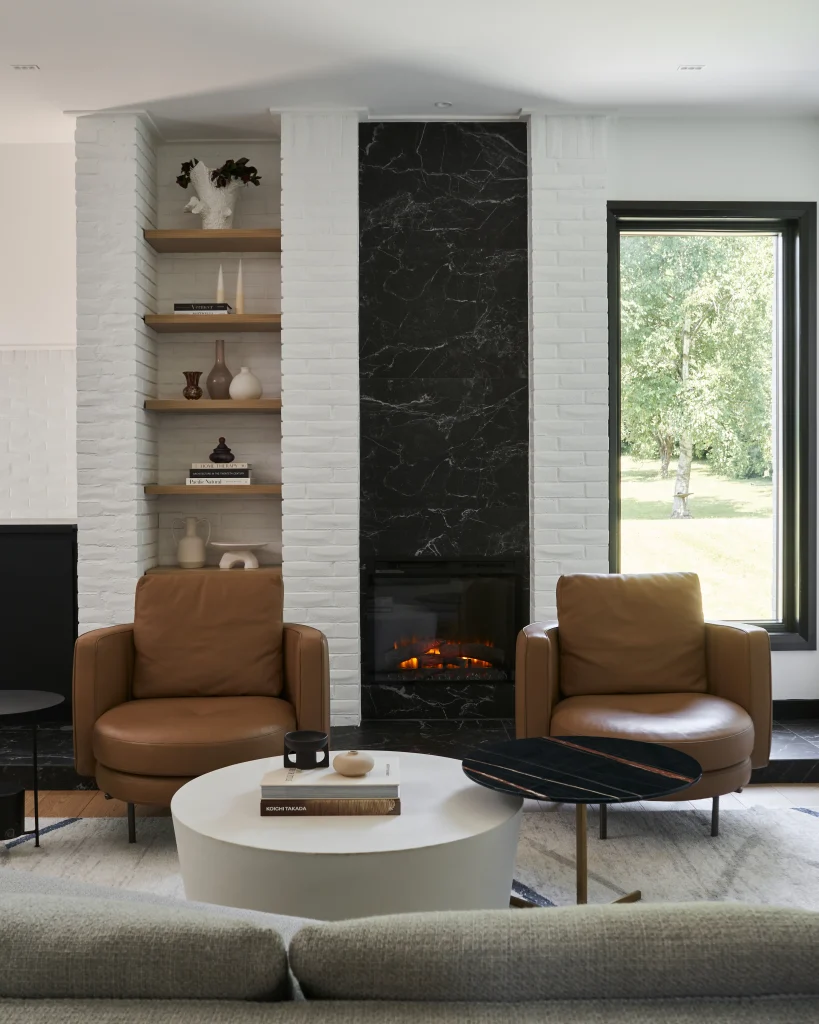
Material: Brushed teak wall planks (Wood) absorb echo, while a ribbon fireplace (Fire) introduces flicker and warmth.
Pattern: A hand-knotted rug maps the Bagua in tonal gradients, guiding Chi without a single visible arrow.
Scent & Sound: Beeswax candles whisper honey while a concealed speaker plays a slow pulse at 60 beats per minute – resting heart rate.
Feng Shui Interior Design Misconceptions
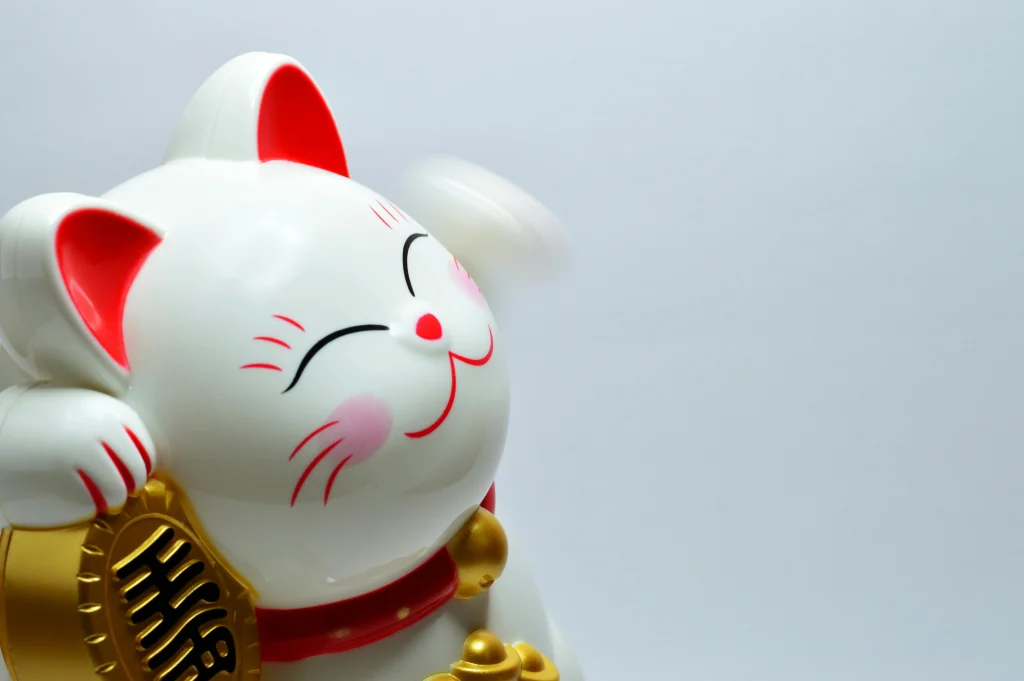
I am often asked if Feng Shui means lucky cats and red tassels. Those can be charming cultural artifacts, but authentic practice is mostly invisible.
The bronze Foo Dog in a Forest Hill foyer appears purely sculptural. Only the family and I know it guards the threshold energetically. When symbolism appears, it must earn its place aesthetically and narratively.
If You Want to Apply Feng Shui Today
Without knocking down a single wall, you can calm restless rooms:
Liberate the entry. Clutter there chokes Chi before it begins its journey.
Angle your bed so you see the door without lying directly in its path. You’ll feel the difference by the third night.
Introduce a living plant. Glossy leaves are Chi’s favorite playground.
Activate key Feng Shui areas. Place gold Yuan Bao with red envelopes in the wealth corner to invite smoother business and stronger financial luck. Position a Wenchang tower in the study or education corner to support children’s focus and academic success.
Small moves, big returns.
Let the Space Sing & Dance
Every project I accept is a conversation between narrative and necessity, cost and craft, memory and aspiration. Feng Shui does not sit on top of that conversation. It threads through, stitching structure to soul. When the thread is strong, clients stop talking about square footage and start talking about how their children linger at the dining table or how sleep now feels like silk.
So, if your home, boutique, or hotel feels beautiful still restless, let’s pour another cup of oolong. Show me where you stand when you call your mother. I’ll show you how wind can travel, water can rest, and stone can learn to sing. Together we’ll coax your space from impressive to unforgettable – until every surface, every silence, every breath inside those walls finally dances.
FAQs
How is professional Feng Shui interior design different from basic tips I read online?
While online tips offer simple adjustments, professional Feng Shui interior design is a deep, architectural analysis. It integrates the Bagua map and Five Elements into your home’s core blueprint, ensuring every structural and aesthetic choice works in harmony to create a truly bespoke and supportive sanctuary.
Will my home look overtly ‘Asian’ if we incorporate Feng Shui principles?
Not at all. Authentic Feng Shui interior design is aesthetically agnostic. The principles of balance, flow, and elemental harmony can be flawlessly integrated into any style, from minimalist modern to classic European. The goal is to elevate your personal vision, not impose a foreign aesthetic.
How does Feng Shui interior design work with my existing art and furniture collection?
It enhances it. A core part of what is Feng Shui interior design involves strategic placement to honor your most cherished pieces. We analyze the energy of each item and position it to create powerful focal points and harmonious conversations between objects, amplifying the story your collection tells.
Is there a tangible return on investment for using Feng Shui interior design?
Yes, beyond personal well-being, it can increase property value. An analysis of condominiums found that units with Feng Shui principles sold for approximately 6.2% higher prices than comparable units. It’s an investment in both your quality of life and your asset.
As a busy professional, what is my time commitment during the design process?
Your time is respected and used strategically. My role is to manage the immense complexity of the project. I distill the thousands of decisions into key, focused workshops for your input. You provide the vision and make milestone approvals, while I handle the intensive day-to-day execution and coordination.
Can Feng Shui principles be applied to a modern, minimalist aesthetic?
Absolutely. Minimalism and Feng Shui are natural partners. The focus on uncluttered spaces, intentionality, and the quality of light and materials aligns perfectly. Feng Shui adds a layer of energetic warmth and flow, ensuring a minimalist space feels serene and soulful, not sterile or cold.
What’s the difference between the Bagua map and the Five Elements?
Think of the Bagua as the life-goal map for your home, linking areas like ‘Wealth’ or ‘Health’ to specific locations. The Five Elements (Wood, Fire, Earth, Metal, Water) are the toolkit – the textures, colors, and materials we use to activate and balance the energy in each of these areas.
Is what you practice a spiritual belief system or is it based on tangible principles?
I approach it as a form of architectural psychology refined over millennia. While its roots are philosophical, the practice focuses on tangible outcomes: how room layouts affect focus, how materials impact mood, and how spatial organization can reduce stress. The results are felt physically and emotionally.
How do you correct a space with inherent ‘bad’ Feng Shui, like a poorly placed staircase?
Correction is about skillful redirection, not demolition. For a problematic feature, we use ‘cures’ – subtle, elegant design solutions. This could involve using mirrors to expand a space, crystals to disperse rushing energy, or specific colors and materials to balance the elements and restore harmony.
How does Feng Shui interior design address modern needs like home offices and technology?
It’s highly adaptable. For a home office, we prioritize the ‘command position’ for focus and reduced fatigue. For technology, we use Feng Shui principles to mitigate electromagnetic fields and integrate smart-home features seamlessly, ensuring your home remains a restorative sanctuary in a hyper-connected world.